I've never liked tramping. I think of it as trudging. Where's the fun in being sweaty and mud-splattered, with your lungs burning and your feet aching, through forest that you never even look at because you're too busy avoiding that cliff you're about to walk over, while it's steadily raining on you?
My first 'tramps' were:
* walks around various lakes in Tongariro National Park 1983 - rain, rain and more rain
* a climb up Mt Pureora during Form 1 camp 1984 - extreme muddiness sucked my shoes off my feet
* a climb up Mt Tarawera 1985 - nobody talked to me all day because for some reason everyone hated me, and although the craters are stunnig, I was sure I was going to get blown over by the gale force winds we endured
All my ventures into tramping or bushwalking or any of that sort of thing have usually been very humiliating, my incredible un-fitness exposing me like I'm tramping naked. I'm not big on discomfort, so wet feet, smelly pits and muddy knees aren't really my idea of a good time.
So when Deb said I should come with her and Gus and Monique on a tramp to a hut in the Orongorongo Valley over Labour Weekend, I was not that keen. Monique lent me a pair of boots, some gaiters, a hat and some gloves. We bought food to take to a hut with us, only three hours up a track.
But I now get it. I get tramping. It's about having the right gear, lots of food, actually choosing to tramp rather than being forced to do it by sadistic teachers, being with people you like rather than kids who hate your guts that particular day and want you to know it, and good weather.
After three hours of pleasant up hill down hill with lunch at the river, we arrived at our luxurious hut. It even had a coffee plunger it was so cool. It was like the Raffles of tramping huts, it was shangri-la, it was an oasis of warm cosiness. Gus went about sawing up the wood that Monq and Deb collected from the riverside. I built a fire good enough to roast on, and we played cards, drank bad vodka, made cups of tea, ate dinner and read trashy magazines left behind by other people. By 8pm, it still wasn't dark and Deb was campaigning hard for dessert.
The next morning, we woke to rain. A few hands of world championship gin rummy, a breakfast of sausages, asparagus and corn thins, followed a couple of hours later by more gin rummy and porridge. A last burst of branch sawing for Gus and we were out of there. On with the boots, the gaiters, the full kit and caboodle and we were tramping, along slippery slopes, through muddy crevasses. Talking about alien invasions and what planet Gus is actually from. It was choice.
October 28, 2005

October 18, 2005
The $10 Road Trip
As police swooped in on the killer of German hitch-hiker Birgit Brauer, Waikato Times reporter KIMBERLEY ROTHWELL hitch-hiked from Auckland to Queenstown for charity. It was a journey she would never have done without two cellphones, a travelling partner and a GPS unit.
SOMEWHERE just south of Otaki, I realised I would probably never hitch-hike again. It wasn't the cars ripping past with empty back seats, or the impending rain. It was the picture of Birgit Brauer I had seen in a newspaper in the last car I had been in.
If I hadn't been in a charity race, complete with uniform, travelling partner, GPS unit and constant cellphone contact with headquarters, I would probably not have put myself in the same risky position Brauer had. But the Accor $10 Race for Cure Kids offered an opportunity to see the country in a way which is now considered by many as unsafe.
I entered the Accor $10 Race for Cure Kids a few months ago. It entailed raising a $2500 entrance fee, and taking part in a three-day 1500km race from Auckland to Queenstown, with only $10 to survive on. Accommodation in Wellington, Christchurch and Queenstown was provided, plus breakfast and dinner. But everything else either comes out of the $10, or the kindness of strangers.
To complicate matters, there were challenges to be performed along the way. On day one, there were stops at Hamilton, Taupo and Palmerston North. Under the rules, each two-person team had to change vehicles at all challenges, so there was no point in getting a lift from Taupo to Wellington.
The Cure Kids event stemmed from a race in the 1970s, when two businessmen bet a bottle of whisky on who could reach Queenstown faster on the $10. The Cure Kids version funds research into children's life-threatening illnesses such as Sids, cystic fibrosis and diabetes. Competitors were challenged to make it across the finish line first, and raise the most money before and during the race.
I embarked on the race with Jo McKenzie-McLean, a Christchurch Press reporter. I expected a race where participants relied on their nous, their wits, their cunning. As journalists, I figured we were a shoo-in.
We compiled lists of contacts –- trucking companies, car clubs, furniture movers –- which we could call on the road for lifts. The rules said we couldn't self-drive, fly, use friends or family, or arrange rides in advance of the race. But by the last day, those rules had been stretched in all directions.
Day One:
The police gave us our first ride; Jo charmed Auckland Central's senior-sergeant into dispatching a couple of officers to take us out of Auckland.
"This city's a shithole," said one officer, who went on to discuss the prevalence of P, how many bashings he'd had from criminals, and why he was a cop.
"It's not about doing it to make a difference," he said. "Anyone who says that is bullshitting. It'd just get you down."
It was the rush of being involved in busting crime, he said. Much like a reporter with a good story.
From the "prisoner" seat, I began calling our contacts but came up with nothing –- it seemed all trucks heading in our direction had left hours ago or weren't going to be at our various stops any time soon.
So it was all up to our thumbs.
The rest of day became a blur of trucks, petrol stations, and rained-out challenges. In Hamilton, it rained while we bounced on moonhoppers around a few cones sprinkled in Garden Place. In Taupo, we fished Fanta bottles out of a paddling pool, as it rained. In Palmerston North, we were dropped off in a thunderstorm to sing karaoke at the local More FM studio. But each time we were dropped off by drivers to hitch another lift, the rain cleared miraculously.
One of the more memorable rides of the day involved Ashley the beagle. A van picked us up just out of Palmerston North. It was lift number eight of the day, we both wanted to get to Wellington, eat and sleep. The two lovely ladies who picked us up were chatty and amiable, but re-telling the story of what we were doing and how it was going was beyond us –- I zoned out, staring out the window. We shared the back of the van with a mattress, microwave oven and Ashley, who looked about 1000 years old, had acrid breath and yawned in our faces as if trying to torture us. I sat on the mattress bouncing up and down on its springs as there were no back seats. Ashley snuffled up to my face and bashed at my hands with her wet nose, demanding a scratch. Cute at first, but the hair, the breath, the all-round smelliness soon had me battling grumpily to get Ashley off, and gasping for some fresh air.
"She's pretty smelly, eh?" her owner chuckled.
The ladies, who'd planned to stop at Levin to let us out, ended up taking us to Otaki, nearer Wellington –- a much better hitching spot, they said. That generosity cropped up in all the competitors' stories –- people who bought lunch for racers, jacked up rides for them, who went miles out of their way to get them closer to a good spot. And if we hadn't been racing for Cure Kids, I doubt any of those people would have stopped for us in the first place.
Day Two:
The question I was asked most in the days leading up to the trip was how did I plan to get across Cook Strait? I called the Interislander, and was told we were already booked on the ferry. Not much of a challenge in that then.
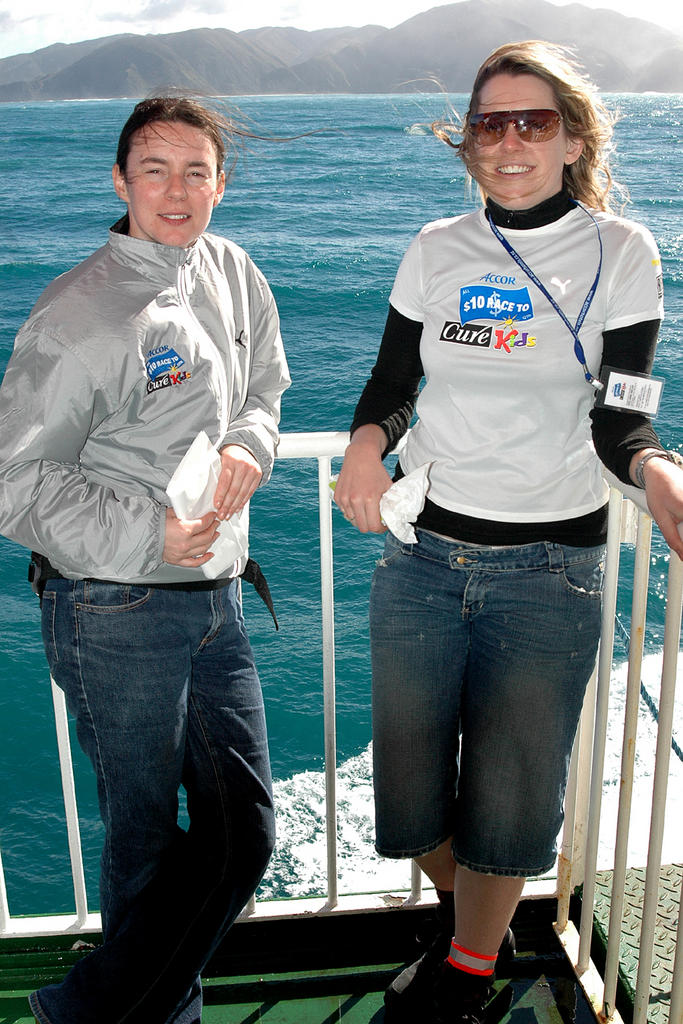
But it came at a price. Four-metre swells thumped the Kaitaki, supposedly the smoother of the two ferries. It was like the apocalypse –- chairs flying, people stumbling, barf bags filling, children crying. Green-looking people clung to the ship's railings, looking rigidly at the horizon. The only Cure Kids racer who didn't look too green was Olympic rower Rob Hamill, who rowed across the Atlantic eight years ago and seemed immune to the thrashing.
We met a couple of women on the ferry going to Christchurch, so the day was easy and dog-free and I came out of it not smelling of anything but the hot chips the Interislander staff fed us.
Day Three:
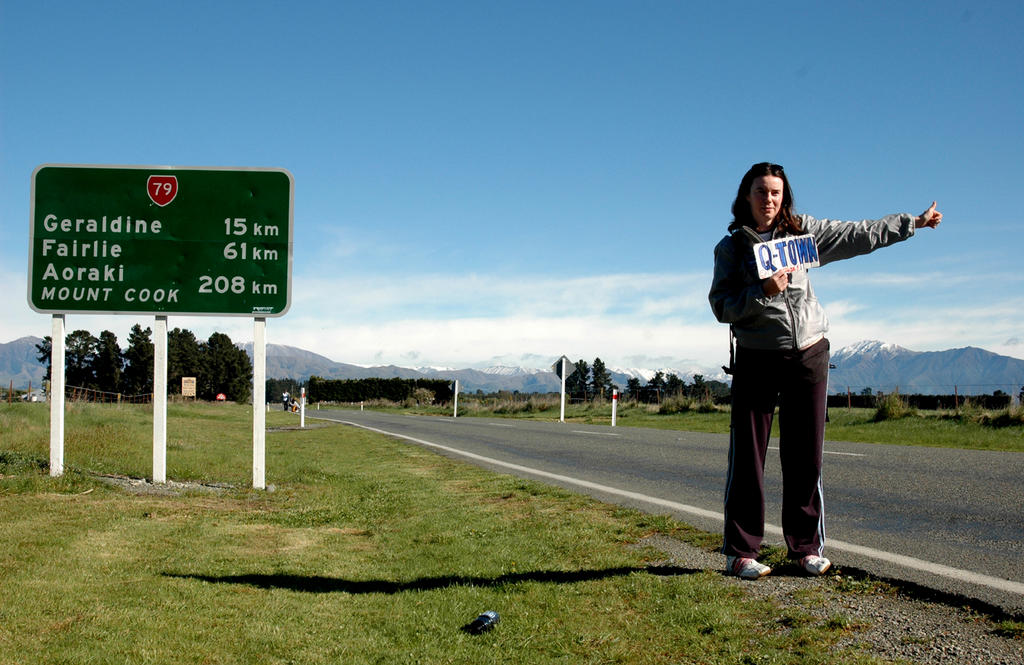
Rangitata on SH1 south of Ashburton bulged with Cure Kids contestants by mid morning, as cars heading south dropped people off at the turnoff to Geraldine and Queenstown. It wasn't long before we were picked up, leaving the other teams stony-faced and sighing. It's easy to be discouraged hitch-hiking. When only one car turns down your road every five minutes or so, you begin to feel no one's ever going to stop.
When we were dropped at Geraldine, Jo and I were determined to get to Queenstown with the least amount of mucking around. The only challenge was to stop at Bendigo Station, somewhere between Tarras and Cromwell in Central Otago, to have our picture taken with a sign.
As we waited for a ride in Geraldine, into our lives walked Frankie. He wore bright blue socks pulled up to his knees, sandals, and a woolly hat. He strolled up to us and asked what we were doing.
"Hop in," he said motioning to his white Nissan stationwagon. "I know where Bendigo Station is. I can take you all the way to Queenstown."
He wasn't keen to give us his name though, but gave in after we whined at him. "I don't like people talking about me," he said. Jo and I looked at each other bewildered. What people? And he refused to have his picture taken. For someone in his late 20s, he had the aura of an old man.
Despite his hermit-like appearance, Frankie was rather chatty. Within minutes of getting into the car he said, "I'm an environmentalist, so I'll be driving at between 90 and 100." He demonstrated his car's ability to pollute by putting his foot down. Black clouds erupted from the exhaust pipe.
"Ninety is the perfect speed for cruising. We're just going to cruise."
So, cruising around 90km/h, he got us to Queenstown half an hour later than he said he would. In the hours we spent with him, he ran over a duckling, made us take photos of Lake Pukaki, told us off for using our cellphones too much –- "less technology, more scenery" –- and waxed lyrical about the advantages of smoking pot over drinking alcohol. In the rush to get to the finish line at the Sofitel Queenstown, he drove off without us saying thank you.
BIRGIT BRAUER hitch-hiked because she met real New Zealanders. After working in Queenstown where she only met other tourists, thumbing rides showed her the real country. She relied on the goodness of human nature, which some may say was naive. Though her death may signal the end of what was once a great New Zealand tradition, and a fine way to travel, it makes me happy to think of all the people who did stop and pick us up, who went out of their way, who gave us their food, bought us lunch, donated money, posed for photos with us, whose human nature we could rely on.
SOMEWHERE just south of Otaki, I realised I would probably never hitch-hike again. It wasn't the cars ripping past with empty back seats, or the impending rain. It was the picture of Birgit Brauer I had seen in a newspaper in the last car I had been in.
If I hadn't been in a charity race, complete with uniform, travelling partner, GPS unit and constant cellphone contact with headquarters, I would probably not have put myself in the same risky position Brauer had. But the Accor $10 Race for Cure Kids offered an opportunity to see the country in a way which is now considered by many as unsafe.
I entered the Accor $10 Race for Cure Kids a few months ago. It entailed raising a $2500 entrance fee, and taking part in a three-day 1500km race from Auckland to Queenstown, with only $10 to survive on. Accommodation in Wellington, Christchurch and Queenstown was provided, plus breakfast and dinner. But everything else either comes out of the $10, or the kindness of strangers.
To complicate matters, there were challenges to be performed along the way. On day one, there were stops at Hamilton, Taupo and Palmerston North. Under the rules, each two-person team had to change vehicles at all challenges, so there was no point in getting a lift from Taupo to Wellington.
The Cure Kids event stemmed from a race in the 1970s, when two businessmen bet a bottle of whisky on who could reach Queenstown faster on the $10. The Cure Kids version funds research into children's life-threatening illnesses such as Sids, cystic fibrosis and diabetes. Competitors were challenged to make it across the finish line first, and raise the most money before and during the race.
I embarked on the race with Jo McKenzie-McLean, a Christchurch Press reporter. I expected a race where participants relied on their nous, their wits, their cunning. As journalists, I figured we were a shoo-in.
We compiled lists of contacts –- trucking companies, car clubs, furniture movers –- which we could call on the road for lifts. The rules said we couldn't self-drive, fly, use friends or family, or arrange rides in advance of the race. But by the last day, those rules had been stretched in all directions.
Day One:
The police gave us our first ride; Jo charmed Auckland Central's senior-sergeant into dispatching a couple of officers to take us out of Auckland.
"This city's a shithole," said one officer, who went on to discuss the prevalence of P, how many bashings he'd had from criminals, and why he was a cop.
"It's not about doing it to make a difference," he said. "Anyone who says that is bullshitting. It'd just get you down."
It was the rush of being involved in busting crime, he said. Much like a reporter with a good story.
From the "prisoner" seat, I began calling our contacts but came up with nothing –- it seemed all trucks heading in our direction had left hours ago or weren't going to be at our various stops any time soon.
So it was all up to our thumbs.
The rest of day became a blur of trucks, petrol stations, and rained-out challenges. In Hamilton, it rained while we bounced on moonhoppers around a few cones sprinkled in Garden Place. In Taupo, we fished Fanta bottles out of a paddling pool, as it rained. In Palmerston North, we were dropped off in a thunderstorm to sing karaoke at the local More FM studio. But each time we were dropped off by drivers to hitch another lift, the rain cleared miraculously.
One of the more memorable rides of the day involved Ashley the beagle. A van picked us up just out of Palmerston North. It was lift number eight of the day, we both wanted to get to Wellington, eat and sleep. The two lovely ladies who picked us up were chatty and amiable, but re-telling the story of what we were doing and how it was going was beyond us –- I zoned out, staring out the window. We shared the back of the van with a mattress, microwave oven and Ashley, who looked about 1000 years old, had acrid breath and yawned in our faces as if trying to torture us. I sat on the mattress bouncing up and down on its springs as there were no back seats. Ashley snuffled up to my face and bashed at my hands with her wet nose, demanding a scratch. Cute at first, but the hair, the breath, the all-round smelliness soon had me battling grumpily to get Ashley off, and gasping for some fresh air.
"She's pretty smelly, eh?" her owner chuckled.
The ladies, who'd planned to stop at Levin to let us out, ended up taking us to Otaki, nearer Wellington –- a much better hitching spot, they said. That generosity cropped up in all the competitors' stories –- people who bought lunch for racers, jacked up rides for them, who went miles out of their way to get them closer to a good spot. And if we hadn't been racing for Cure Kids, I doubt any of those people would have stopped for us in the first place.
Day Two:
The question I was asked most in the days leading up to the trip was how did I plan to get across Cook Strait? I called the Interislander, and was told we were already booked on the ferry. Not much of a challenge in that then.
But it came at a price. Four-metre swells thumped the Kaitaki, supposedly the smoother of the two ferries. It was like the apocalypse –- chairs flying, people stumbling, barf bags filling, children crying. Green-looking people clung to the ship's railings, looking rigidly at the horizon. The only Cure Kids racer who didn't look too green was Olympic rower Rob Hamill, who rowed across the Atlantic eight years ago and seemed immune to the thrashing.
We met a couple of women on the ferry going to Christchurch, so the day was easy and dog-free and I came out of it not smelling of anything but the hot chips the Interislander staff fed us.
Day Three:
Rangitata on SH1 south of Ashburton bulged with Cure Kids contestants by mid morning, as cars heading south dropped people off at the turnoff to Geraldine and Queenstown. It wasn't long before we were picked up, leaving the other teams stony-faced and sighing. It's easy to be discouraged hitch-hiking. When only one car turns down your road every five minutes or so, you begin to feel no one's ever going to stop.
When we were dropped at Geraldine, Jo and I were determined to get to Queenstown with the least amount of mucking around. The only challenge was to stop at Bendigo Station, somewhere between Tarras and Cromwell in Central Otago, to have our picture taken with a sign.
As we waited for a ride in Geraldine, into our lives walked Frankie. He wore bright blue socks pulled up to his knees, sandals, and a woolly hat. He strolled up to us and asked what we were doing.
"Hop in," he said motioning to his white Nissan stationwagon. "I know where Bendigo Station is. I can take you all the way to Queenstown."
He wasn't keen to give us his name though, but gave in after we whined at him. "I don't like people talking about me," he said. Jo and I looked at each other bewildered. What people? And he refused to have his picture taken. For someone in his late 20s, he had the aura of an old man.
Despite his hermit-like appearance, Frankie was rather chatty. Within minutes of getting into the car he said, "I'm an environmentalist, so I'll be driving at between 90 and 100." He demonstrated his car's ability to pollute by putting his foot down. Black clouds erupted from the exhaust pipe.
"Ninety is the perfect speed for cruising. We're just going to cruise."
So, cruising around 90km/h, he got us to Queenstown half an hour later than he said he would. In the hours we spent with him, he ran over a duckling, made us take photos of Lake Pukaki, told us off for using our cellphones too much –- "less technology, more scenery" –- and waxed lyrical about the advantages of smoking pot over drinking alcohol. In the rush to get to the finish line at the Sofitel Queenstown, he drove off without us saying thank you.
BIRGIT BRAUER hitch-hiked because she met real New Zealanders. After working in Queenstown where she only met other tourists, thumbing rides showed her the real country. She relied on the goodness of human nature, which some may say was naive. Though her death may signal the end of what was once a great New Zealand tradition, and a fine way to travel, it makes me happy to think of all the people who did stop and pick us up, who went out of their way, who gave us their food, bought us lunch, donated money, posed for photos with us, whose human nature we could rely on.
October 11, 2005
Cure Kids $10 Race - evidence that I was really there

Some pictures from the Accor $10 Race for Cure Kids 5-7 October 2005
1: Rangitata turnoff between Chch and Geraldine on Day three
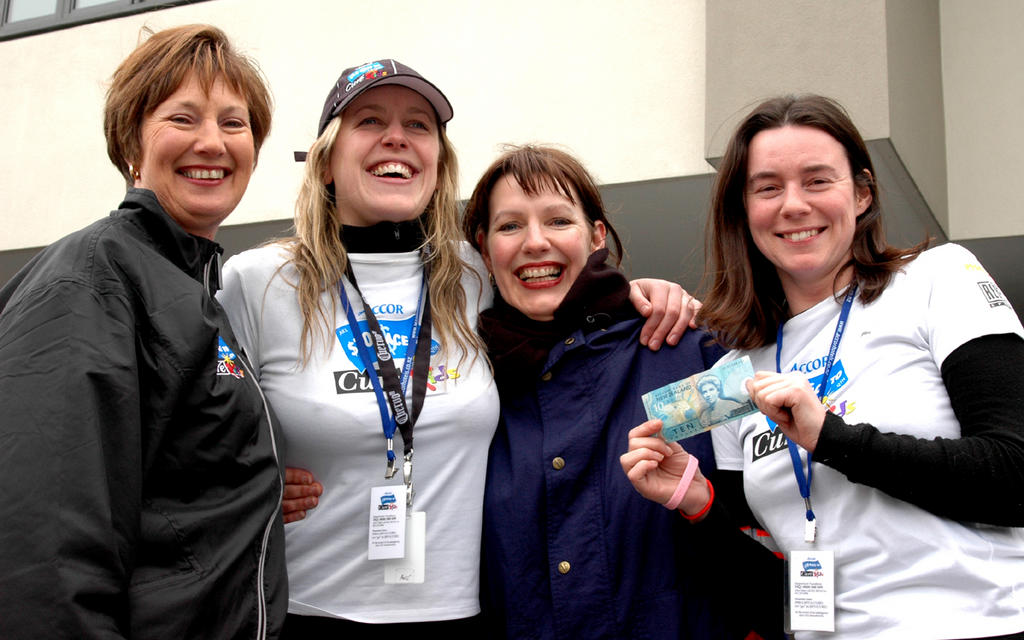
2: The end of the race, Me, Ben Watson from North Shore Times, Jo McKenzie-McLean from the Chch Press
3: Me and Jo clutching our puke bags on the Ferry
4: Crossing the line at Queenstown with our $10s untouched; Thelma French, Jo, Jo's Mum, Happy Kimpy
Subscribe to:
Posts (Atom)